søndag den 25. april 2021

Zoom in to Moscow for a roundtable on genre

Thursday there will be a roundtable on cognitive genre studies in Moscow. I looks like something one should attend. However, in these COVID19-times, we can all participate over zoom and from the comfort of home. Not that I'd mind going to Moscow, mind. But the travel time to my home office is admittedly shorter. Meet me in virtual Moscow Thursday and remember to take the time difference into account.  

Among the speakers is Michael Sinding whose work on the topic is admirable. I look forward to hearing him. He will speak alongside Russian colleagues whom I don't know but look forward to admiring as well. Read more here.


søndag den 14. marts 2021

Apologies done right

This blog has previously discussed apologies if for no other reason then because they are an extremely fascinating genre. As mentioned here (with further references; in particular to the best genre blog ever to exist) a true apology has four features.
  • sincere, genuine
  • no "but"s (as in, "I'm sorry, but here's my excuse")
  • specific about your own actions
  • commitment not to repeat the offending action

Simple as that may sound, it often fails. Probably, but I am speculating, because the first point, which is on the surface of it the most flimsy of the four, gets in the way of the other three. It is very hard to look like you assume blame unconditionally if you don't mean it; and it is equally hard to commit to not repeating an offense if you're actually not convinced you've done something wrong. However, sometimes, just sometimes, it's done right. Here is an example of what to do if you've put your foot in it (or, as we'd say in Danish, "stepped in the spinach planting" ("trådt i spinatbeddet")).


Friday March 12th, 2021, an MBA education at the University of Southern Denmark (SDU)—usually the epitome of respectability—published an advertisement article in order to convince private enterprises that they needed the expertise of the MBA-education to handle Metoo properly. Now, I have no idea how the text came about but it managed to make female employees—not sexual harassment against them—into the Metroo-problem they would teach their prospective MBA-students how to handle. Personally, I'd rather take sensitivity classes from a rhinoceros. My wife stumbled upon it and pushed it into my hands. So, trying to ally up a bit, I called out the SDU in a Danish-language thread on twitter.
    Now, I don't carry a lot of weight on Danish twitter, but this one had the potential to do some damage anyway, if the ball started rolling. The twitter account doesn't need to be that heavy for the impact to be. It was picked up quickly, and it could have grown into a major crisis at a considerable speed. However, someone at SDU had a watchful eye out (also, I did tag them like three or four times in the thread), and it was a question of mere hours before this reply appeared:


It translates like this:


Dear everyone. We support #Metoo. The advertisement was not an expression of SDU's values or politics. It is discriminatory. We hereby offer an unconditional apology. We are going to give the internal processes at @SAMF_SDU (The faculty of Social Sciences. SA) a serious quality check. Thank you for reacting to the advertisement.

The Dean of the Faculty was equally quick. Here's his reply. Shorter, but no less to the point.


Translation:


Sometimes you just have to surrender unconditionally*. SORRY, SORRY SORRY. There's really not much more to say. We must do a lot better...

Much as I did not admire the original advertisement, I do admire this reaction. The reply from the central, and more formal, account is centralized and quite formal. It speaks on behalf of the university and it apologizes with a description of how the advertisement violated the central values of the university. Knowing how heavy institutions universities are, I'd suggest this reply has taken some work to establish and ensuring the necessary approval. It performs every point of the apology right. It is sincere and devoid of states the transgression with clarity "it was discriminatory", and it promises systemic improvement on the relevant point as would be expected of the systemic level of a university as represented by the official twitter-account of the university.

The Dean is the leader directly responsible for the advertisement, even if chances are he only ever read the advertisement after seeing the criticism. Therefore, the statement has to be more personal to do the work involved. And lo and behold, it IS more personal. You can almost taste the abject exasperation at the situation. The specificity is a little less defined than in the more official tweet, but the double emphasis (triple word + upper case) plus the declaration of unconditional surrender more than makes up for it. Moreover, there's still not a trace of an "if" or a "but", and the promise of improvement is very strong and once again with a double marker: the statement itself, and the three "to be continued" full-stops at the end of the tweet.

Knowing a bit about how deans work, I know what kind of trouble I would have been in during my days as middle management at the University of Copenhagen if my actions had forced the dean into making such a statement publicly. In this situation that knowledge, I admit it, affords me a certain grim satisfaction.

The apology is a rich, and somehow magical, genre. I sometimes say that it can transform transgression to community. In the case of institutional apologies like those in question they do additional work. The first is damage control. By absolutely refusing to defend the statement, the university and the faculty secures that the fallout is kept at a minimum and that responsibility for the statement is limited to the institution which made it in the first place.
    Moreover, as many other institutional crises, this one offers a chance for an improved practice, but only if it is taken seriously. In heavy institutions like universities you often only learn through blunderers. You find yourself having put your foot in it, and this gets you asking what "it" is. So, the commitment to not repeat the offending action is also an opportunity to improve on an existing institutional practice. Thus, stupid as the original action was, the University of Southern Denmark may actually find itself a better institution for it. Uptake, as always, is almost everything.


* The Danish reads "lægge sig fuldstændig fladt ned" which literally translates as "lie down completely flat." It's an idiom, but its literal meaning adds to the sense of surrender in the expression.

fredag den 5. marts 2021

Genre in the Climate Debate

After a long wait, Genre in the Climate Debate, is out. It is a research anthology I have edited alongside a very old partner-in-crime, Christel Sunesen of the micro-publishing house Ekbátana (named, I believe, after a poem by Danish master poet Sophus Claussen—no, the Wikipedia-article doesn't even begin to do him justice) with whom I have also published this book on Grundtvig and genre (in Danish). It's been a long wait and as you can see from the volume the afterword was written in August 2019.  But fortunately most of its value hasn't suffered from the protracted publication process. And anyway, protracted publication is another name for "academic publication". Good friends helped me formulate some of the presentation for the Det Gruyter homepage, and it ended up looking like this: 

The presentation of the book on the De Gruyter homepage reads like this:

Benefits

      • The volume establishes a dynamic interplay between two high-level research fields: humanistic climate studies and genre research

      • The volume offer an understanding of the way the structural and ideological issues in the debate over anthropogenic climate change are determined by the genres in play in the debate.

      • The volume continues key developments in contemporary genre research, in particular the use of genre in political campaigning and the uptake of genre information and action across genre systems.


The greatest conundrum concerning anthropogenic climate change may prove to be in the humanities and the social sciences. How is it even possible that highly exigent information for which overwhelming evidence exists does not make an immediate and strong impact on ideologies, policies, and life practices across the globe? This volume offers an intriguing and enlightening new approach to the the climate debate by taking it as a question of genre. Genres are the cultural categories that structure human understanding and communication, and genre research therefore offers a central key to unlocking the conundrum. From a genre perspective, if there is one thing the climate debate demonstrates, it is the inertia inherent in genre use. Patterns of understanding and interpretation once established seem to carry on even when they have long outlived their usefulness.

However, it is also evident that uses of genre can work to change this inertia. Genres play a vital role in human interaction, as we use them to learn, express ourselves, and to act. How individual actors utilize or manipulates genres determines to what extent knowledge of climate change spreads from the scientific community to the public, how it is debated, and to what extent it leads to positive action.


I am, obviously, very happy to see it published. The long wait involved in having edited volumes means that people will submit to you and then you'll keep them in a year-long standby while you wait for all the cogs, wheels and gears to work together. So the release when the book is finally there is palpable.

But there's also another sort of release in a book like this. For decades, literally, I have been scared to the point of paralysis about anthropogenic climate change, and I'm not alone in being paralyzed. In fact one of the most eye-opening studies I read in preparation for the volume deals with "The Dragons of Inaction"—understood as the psychological barriers that hold us back from taking intelligent action on anthropogenic climate change. However, on having finally actually engaged with the topic, I find it less scary, not because it turns out to be less real on closer inspection, or even less dangerous, but because I feel less powerless,  since now I experience that I am at least doing something. Moreover, I find that acting also breaks isolation, because it leads me to meet, discuss, and sometimes even work with engaged researcher from other fields equally engaged—sometimes even in a much more committed way—to making a difference. Shared worry is half worry, and shared strength is double strength. Happy to add mine.


mandag den 15. februar 2021

Threats, not-threats, genre, and the Strange Case of the Suspended Bretwalda

We always understand genres, Anne Freadman has usefully explained, as alike, but different from, other genres. Adding to this, a central feature of genre use is its dialogicity (from Mikhail Bakhtin, obviously): uses of genre arise as responses to, or uptakes of, previous genre use, and in turn try to secure what kind (genre) of response it will get; in almost all cases without ever being able to fully secure it beforehand. There's always the free action of the next agent to contend with.

The strange paths of academic life have led me to play a small part in the study of threats as carried out by Forensic Linguistics; and alongside good colleagues, Marie Bojsen-Møller, Tanya Karoli Christensen and Amy J. Devitt, I have even published a research article about threats and genre. 

Forensic Linguistics addresses criminal threats, a highly pertinent subjectwhich is, alas, of increasing importance. However, there's another side to threats which is not as important to Forensic Linguistics but interesting and relevant in other contexts. Many of these other kinds of threats are legal, and some of them are even useful—or fun. But I get ahead of myself.

Threats, research states (the references are in the article above), consist of three elements. 

  • Futurity
  • Sender's responsibility
  • Recipient's harm
As in "I (sender) shall (futurity) do (responsibility) this bad thing (harm) to you (recipient)". The purpose of the threat is intimidation. There may be other purposes, but this one is overriding. A threat is usually made illegal by the character of the harm it threatens to cause. If someone threatens you with public rebuke, it may be unpleasant, but it's not usually illegal; if they threaten you with a beating, it's illegal, because the beating is.

As a genre researcher originating from the field of literature I've been interested in how rhetorical genres are recontextualized and used as elements in fictions. This goes for threats too. Fictive threats confirm to other threat except for one thing: They don't exist; or rather they exist as parts of a fiction and as such the proposed harm is also fictive. Thus, they don't really intimidate anyone outside the fiction, or at least they are not meant to, and reporting them to various authorities is a failure of genre. Let us call them not-threats for the sake of the distinction and recalling Freadman's distinct idea of the not-statement which, to be meaningful, must imply a similarity as well as a difference. Thus, it is meaningful to say that a refrigerator is not a deep freezer, but it is almost never meaningful to say that it is not a rhinoceros—true as the statement may be, it conveys very little information. 

One more (well-known) piece of information about threats: They are prevalent on social media; very often as part of a pattern of abuse and harassment, and thus usually reportable per Terms & Services on the various SoMe platforms. Also making threats will usually get you kicked off the site—unless, of course, you happen to be a patently useless American presidentbecause then you need to actually attempt (AND fail) to overthrow Western democracy in order to get shut down.

All of this brings me to Blate. This is his portrait.


A really good-looking helmet, would you not say? And also an account on twitter—or a series of accounts as you shall see.

I don't actually know who the operator of the accounts is, and it really doesn't matter. Blate, in his various instantiations, is a person on twitter pretending to be not a secret agent but a Bretwalda, that is an old Saxon king from around the 8th century. Aside from some sharp, but fairly centrist, political commentary, Blate engages in behavior fitting of a fairly badly informed and definitely not very civilized Saxon lord. He fights Danes, in fact many of my interactions with him are about precisely this. Sometimes he resists Danish occupation of English territory, The Danelaw, or anachronistically shells Copenhagen (as in 1807). He also lumps Swedes, Norwegians and Finns as "Danes" while he is at it and calls his (equally fictive) housecarls "TO THE SHIELDWALL" when he sees a "Danish" flag; even if it's white with a light blue cross. Also, he has a long standing battle with another twitter account concerning the right order of jam and cream on a scone. They are approaching 500 almost consecutive days of battle as I write this. The nickname "Blate", btw, is derived from one of his earlier forms where his twitter handle was @BlatantLie. 

Not recognizing him as a role-playing account is a failure of genre. 

Enter threats. Or rather not-threats. Befitting a warfaring, somewhat uncivilized, Bretwalda he frequently threatens to behead people. Now, given that he is a fictive character acting as Saxon lord, this is hardly very intimidating. And his twitter-correspondents all expect to be challenged to a duel to the death by axe or by scone. Formally speaking, the statements fit the threat as genre; as in "I Bretwalda (sender) shall (futurity) do (responsibility) the beheading thing by scone or battle-axe (harm) to you (recipient)". However, the point isn't intimidation (or rather: the intimidation is fictive), so all his correspondents invite his threats on purpose and take them up as lovely occasions for witticism. These are not-threats. Taking them as threats is a failure of genre.

And yet, SoMe being what it is, sometimes it happens. Somebody, possibly many people, stop by and report the not-threats as threats to twitter. The uptake transforms the not-threat to a threat, even though no one was ever threatened, much less intimidated. And the Bretwalda, just being an long-dead Saxon lord and not a criminal American president, gets suspended. This, of course, is a failure of Twitter's safety team in interpreting the full communicative action and context, the full genre use, of the not-threats, but given just how many reports they have to handle I can see how it happens. 

And Blate comes back. Always with his beautiful helmet and his quirky demeanor to do battle against the Danes and for jam before cream on a scone. Until the next time someone fails to recognize the distinction and interplay between two genres that are alike yet so so different. The threat and the not-threat.


tirsdag den 25. august 2020

Carolyn Miller, Anne Freadman, some responses, and the joy of theory

 Theory for theory's sake is usually the sole realm of pure blooded nerds within a given research field. Thus, much as I may go on about genre and much as I will insert a discussion of genre into well-nigh everything, I could not come up with sufficient students for a full-on genre theory course if my life depended on it. To make matters worse, there is at present no dedicated journal for genre research, so the field has an uneasy existence publication wisehaving to recurrently insert itself into scholarly debates about other topics. It's doable, but it requires a fair bit of intellectual dexterity and all but excludes genre theory. Publication wise, Genre research thus exists mainly in individual articles and in topical anthologies. Many are excellent, but genre theory has a hard life fitting into these formats.

So, it's a rare and treasured moment when you get the chance to dive into genre theory with other researchers. The Canadian Journal for Studies in Discourse and Writing/Rédactologie graciously hosted a section of genre theory in its most recent issue (here), and I was even more graciously invited to participate. The occasion was an article by Anne Freadman (here) containing a response to Carolyn Miller's pioneering study "Genre as Social Action" (1984) (here). 

If you are in the know about genre research, you'll see at once that this is one of the most interesting meetings you could ever establish. Both researchers belong in the category, I once called "Eminent women in genre research" and for good reason. Miller's article is usually seen as at least one of the central starting points for contemporary genre research. In my own article I try to frame her influence like this:

Carolyn Miller’s (1984) “Genre as Social Action,” the primary topic—or target—of Anne Freadman’s brilliant and thought-provoking article, holds a special place in genre research. If I pick up an unknown piece of research on genre, the first thing I do is look for Miller’s article in the bibliography. If it is not there, the text in my hand will probably be of little value to my work for lack of orientation. (161)

 Anne Freadman on her side is a later influence, but it's not unfair to say that the last decade or so has seen a meteoric rise in her reception. If you read contemporary genre research her  seminal concept "Uptake" is everywhere. So, if we see this as battle, it is a Clash of the (Genre) Titans. The exchange is everything you could possibly hope for. Freadman lucid, friendly, unexpected (as you would, paradoxically, expect from her) and completely to the point. Miller on her side (here) is brief, clear, and very good at knowing when to hold and when to fold. 

This is all brilliant. I've known for quite a while that the exchange would come out, and I've been terribly excited to read the whole thing. But the Canadian Journal for Studies in Discourse and Writing/Rédactologie knew what they had and chose to go over and beyond, so they added three more articles—each a commentary on Freadman's original article. The two other commentators, Janet Githrow and Charles Bazerman, are both forces to be recognized  in genre research with a long line of brilliant publications to their name.  I'm not going to say very much about their contributions at this point as I'm only beginning to figure out what their place in the debate is. Suffice it to say that both contributions display the intellectual rigor  and breadth of vision, I've come to expect from the authors.  I will learn a lot from both, once I get my head fully around them (Gilthrow here, and Bazerman here as well as mine here). It is worth noting that we were only given Freadman's article, not Miller's response, and I think that was a prudent move because it took away the urge to adjudicate between the two.

Be that as it may. The whole section now reads not "just" like an exchange between two brilliant researchers, but as an exploration of the foundation and scope of genre research. There is food for thought for many a year ahead. I cannot congratulate  the Canadian Journal for Studies in Discourse and Writing/Rédactologie enough for this section. 

tirsdag den 17. marts 2020

Birthday greetings. Or: How people can use genre to be just lovely

My daughter, Elisabeth, turns six today. Under the Corona-virus lockdown we don't really have the opportunity to throw her a big party. She had been looking forward to a bash, so it was a bit of a downer. So, I called out across twitter to post pictures and gifs of nice animals for her to enjoy for her birthday.

If you ever need a pick-me-up because people can be awful, here's a little antidote showing that people can be lovely too. 500+ people taking time out to wish a girl they don't know happy birthday with pictures of cute animals. It's really quite overwhelming. Today, the birthday greeting is my favorite genre. Tele-Hugs from me for everyone.

Billede

Update a few hours later: We are now past 700 cuddly "birthday animal pictures". I am getting a very nice sort of genre overload.

fredag den 13. marts 2020

Bad Joke Friday jokes

What is a blog on genre without a collection of bad jokes?

By consequence: over on Twitter it's what they call #BadJokeFriday. It seems quite necessary as we are all isolating from each others to avoid coronavirus. So, in the spirit of the day I've formed my daily reminder as a call for giggly bad jokes. You can see the tweet and the jokes first hand here. But here are the jokes the tweet draws out. I'll add more as they appear. I guarantee you a groany experience. 

Incidentally, (and not speaking too much about genre labels this time around), what is known as a "dad joke" in English is called an "onkelvits" (uncle joke) in Danish. I have no idea why lame jokes are parental in English, but avuncular in Danish.  

Update: I'm going to add in later jokes as they appear on my twitter timeline. Just for the giggles.


Billede

1. Q. What do you call a snowman’s dog? A. A slush puppy!

2. Man at vet:
"I think my dog is a blacksmith""Why do you think that?""Because every time I kick him he makes a bolt for the door" (Note: No pets were harmed during the making of this joke) 


3. A priest, a nun, and a rabbit walk into a bar. The rabbit says, "I think I might be a typo." 


4. Due to this year's increase in the twitter character limit, I need to rethink my seasonal joke about the Easter Rabbi 

Billede 


 5.  Name 3 fish, beginning and ending with K
Killer Shark,
Kwiksave Haddock,
Kilmarnock - a plaice in Scotland


6. I would make a joke, but I broke my arm and I now have no sense of humerus. 


 7. Why have elephants got big ears? Because Noddy wouldn’t pay the ransom. (Literally the only joke I know)


 8. What do you call a fish with no eyes?A fsh.


9. Q. How many surrealists does it take to change a lightbulb? A fish. 


10.  So, the Past, the Present,and the Future all walked into a bar at the same time. The barman asked ‘Right gents, which of you was here first?’ It was Tense. 


11.   You want a bad joke? You asked for it. Q: What have Henry VIII and Winnie the Pooh in common?A: They have the same middle name.

12. Frog's car broke down.Got toad away. 

13. An Englishman, a Frenchman, an Italian and a German were sitting in a room. A man enters and asks "May I join you?" and the reply was... "Yes" "Oui" "Si" "Ja". 

14. Have you heard the one about the Republican Senator who thought Muffin the Mule was a sex offence? 

15. Due to the worsening situation, I've upgraded the musical accompaniment to my hand washing to Wagner's Ring Cycle. Doesn't leave much time for anything else, but safety first. 

16. Q. What do dogs out walking leave behind, that's long, brown and sticky? A. A stick! 

And here begins the new set of jokes ref the update above.

17. Q. How many guitarists does it take to play 'stairway to heaven?'
A. Apparently all of them. 

18. Professor X welcomes a new recruit: “Greetings, friend! What, pray, is your super skill??”
- “Why, Hindsight, professor!”
- “Well that’s not very useful, is it??” 
- “Ah, yes ... I see that now” 

19. My friend thinks girls in uniforms are sexy, but it's all the same to me! 
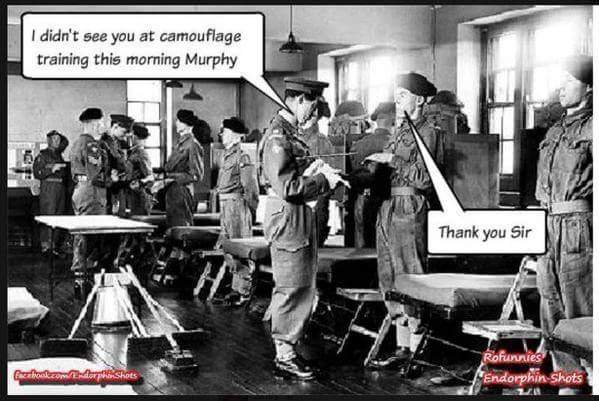
19½: My wife thinks men in camouflage are sexy, but I can't see it myself. 

Billede

20.  I can't find my hi-viz jacket.
- You should demand your money back.

21. How does a poorly baby sheep get to hospital? By Lambulance. 

22. What do you get if you cross an elephant with a rhino?...Elephino

23. I bought some shoes off a drug dealer- I don’t know what he laced them with but I’ve been tripping all day!

24. And God said to John “ come forth and you shall have eternal life” but John came fifth and won a toaster. 

25. Yesterday I changed a lightbulb, crossed the street and walked into a pub. My life's a joke.

26. John Travolta got Corona, he's got chills, they multiplying but now he's ok, turns out it was just a Saturday Night Fever... so he is Stayin' Alive.

27. Tribal chief hit by ceremonial chair falling from his attic. The headline: “People in grass houses shouldn’t stow thrones.”

28. My girlfriend left me because I was too insecure.
...
....
.....
......
No, wait, she's back, she was just fetching coffee. 

29. I was driving along & my boss rang & said 'You've been promoted' & I swerved.Then he rang up a 2nd time & said "You've been promoted again' & I swerved again. He rang a 3rd time & said 'You're managing director' & I went into a tree.I told the policeman I careered off the road. 

30. A friend in Germany tells me everyone’s panic buying sausages and cheese. They fear the Wurst Käse scenario. 

31. Why don't ants get sick? Because they have little anti bodies. 


32. Q: Where does the General keep his army?A: Up his sleeve-y. 


33. Someone keeps topping up my allotment with soil overnight - it's a mystery.The plot thickens. 

35. My wife had just found out I replaced our bed with a trampoline. She hit the roof. 


36. -Waiter, there’s a fly in my soup!
 -I know sir, it’s Fly Soup. 

37. "Your test results have come back." "OK, doc, what's the verdict?""You have acute angina.""Look, I came here for help, not be be ogled at!"

38. "Doctor, I think I'm allergic to leather!" "Why's that?" "Every time I go to bed with my shoes on, I wake up with a headache." 

39. "Doctor, I think I'm allergic to tonic water"
"Why's that?"
"No matter what I mix it with, I end up stone drunk!"